1. Introduction
Healthcare revenue cycle that looks functional on the surface can be quietly bleeding money. Medical claims go out, some come back, others may disappear into payer queues. The difference between a healthy healthcare organization and one that is chronically short on cash often comes down to one question: Are the right revenue cycle health metricsbeing tracked?
RCM metrics in healthcare are not just reporting tools, but also they are diagnostic instruments. When you know which numbers to watch and what they are telling you, you can spot revenue leakage before it compounds, fix process gaps before they become systemic, and demonstrate financial performance improvement in terms that leadership and payers both understand.

2. What Defines a Healthy Revenue Cycle?
A healthy revenue cycle is not simply one that collects most of what it bills. It is one that collects quickly, accurately, and at the lowest possible administrative cost. Three qualities define it most clearly.
- Efficiency: The cycle moves without unnecessary delays. Claims are submitted promptly, payer responses are tracked in real time, and follow-up happens before accounts age into write-off territory.
- Accuracy: The right codes, the right modifiers, the right patient data, and the right payer rules are applied consistently at every stage. Errors that reach the claim level cost money to fix and time to recover.
- Speed: Days in accounts receivable stay low. The time between delivering a service and collecting payment for it is compressed through clean front-end processes, smart automation, and disciplined denial management.
How to measure revenue cycle health starts with understanding how your organization performs across all three of these dimensions simultaneously, not just one in isolation.
3. Core RCM Metrics to Track
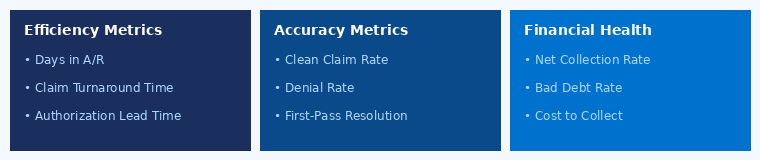
Top RCM metrics healthcare organizations should trackfall into three natural categories, each measuring a different dimension of cycle health.
Efficiency Metrics
- Days in Accounts Receivable: The single most watched efficiency metric in healthcare finance. Days in accounts receivable in healthcaremeasures how long, on average, it takes to collect payment after a service is rendered. Under 40 days for physician practices and under 50 for hospitals is the standard target. When this number climbs, cash flow tightens, and operational risk rises.
- Claim Turnaround Time: How quickly claims are submitted after a patient encounter. Delays in charge entry and claim generation extend the payment cycle before it even begins. Best-practice organizations submit claims within 24 to 48 hours of service.
Accuracy Metrics
- Clean Claim Rate: The percentage of claims accepted and processed on the first submission without errors. Industry leaders maintain a clean claim rate above 95%. Below 90% signals systemic problems in coding, documentation, or eligibility verification that are costing real money in rework and delayed reimbursement. GeBBS Healthcare Solutions has helped clients move from sub-90% clean claim rates to above 96% within two quarters through a combination of iCodeONE® AI coding and front-end data validation workflows.
- Denial Rate: The denial rate in healthcare is the percentage of submitted claims rejected by payers. A rate under 5% reflects strong front-end processes. Anything above 10% demands immediate root-cause investigation by payer, specialty, and denial reason code.
- First Pass Resolution Rate: The share of claims paid on the first attempt. This metric sits at the intersection of accuracy and efficiency. A first pass resolution rate above 90% means that the front-end work, from eligibility checks to coding, is functioning as it should.
Financial Health Metrics
- Net Collection Rate: The gold standard of revenue cycle financial metrics. It measures the percentage of collectible revenue that was collected after contractual adjustments. Anything below 95% means revenue that was rightfully earned is not being recovered.
- Bad Debt Rate: The bad debt rate in healthcare reflects the percentage of patient and payer balances that ultimately cannot be collected and must be written off. A rising bad debt rate often signals problems in patient financial counseling, early balance communication, or payment plan accessibility.
4. Warning Signs of Poor Revenue Cycle Health
Medical billing metrics do not just measure performance. They send early warnings when something is going wrong. Here are the signals most organizations miss until the damage is already done.
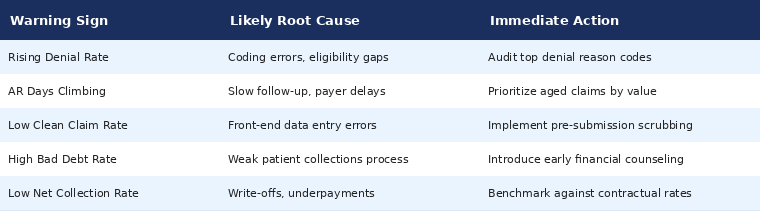
The organizations that catch these warning signs early are the ones running structured weekly reviews of their operational KPIs, not waiting for end-of-month reporting to reveal what could have been fixed two weeks ago. GeBBS Healthcare Solutions builds this discipline into every client engagement through structured performance cadences, where denial spikes and AR anomalies are flagged and addressed within the same billing week they appear.
5. How to Improve Each Metric
Ways to improve healthcare revenue cycle performanceare not one-size-fits-all. Each metric responds to a different lever: process design, staff capability, or technology. GeBBS Healthcare Solutions uses a layered approach across all three, helping clients address the root cause of each metric issue rather than treating the symptom alone.
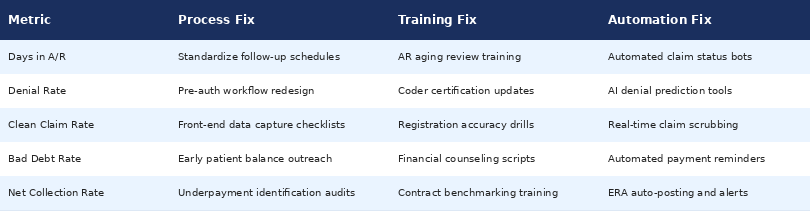
The common thread across every metric improvement strategy is speed of feedback. The faster a billing team knows that something went wrong, the less it costs to fix. Weekly audits, coder scorecards, and real-time denial alerts compress the time between error and correction dramatically.
6. Role of Data Analytics in RCM

Healthcare revenue cycle performancetoday is inseparable from the quality of data infrastructure supporting it. Organizations that rely on spreadsheets and manual reporting are always looking backward. Those using modern analytics platforms are looking forward.
Predictive Analytics
Predictive models built on historical claims data can now identify which claims are likely to be denied before they are submitted. These systems analyze payer behavior patterns, code combinations, and documentation completeness to flag high-risk claims for human review. The result is a measurable improvement in clean claim rate without additional manual workload. GeBBS Healthcare Solutions integrates predictive denial scoring directly into the pre-submission workflow, so high-risk claims are reviewed by a specialist before they ever reach the payer.
Performance Tracking
Real-time dashboards that surface RCM metrics in healthcare by payer, provider, and service line give revenue cycle leaders the context they need to act. When an individual payer’s denial rate spikes, or when a specific facility’s AR days trend upward, a well-configured analytics platform surfaces that signal within hours, not weeks. This is the difference between managing by exception and managing by surprise.
| Key Insight: Organizations using real-time RCM analytics platforms report an average 18% reduction in denial rates within the first six months of implementation, compared to those relying on monthly batch reporting. |
7. Building a Continuous Improvement Strategy
The revenue cycles that perform best year over year are not the ones that have had a single successful optimization project. They are the ones who built continuous improvement into their operating rhythm.
Benchmarking
Reducing AR days in healthcareand sustaining that improvement requires knowing where you stand relative to peers. Internal trend data tells you if you are getting better or worse. External benchmarks tell you if better is actually good enough. Use both. Compare your metrics against specialty-specific and facility-type-specific benchmarks, not just general averages that may not reflect your payer mix or patient population.
Iterative Optimization
Continuous improvement in RCM means treating every denial, every aging account, and every coding error as data. Each incident should feed back into training, workflow adjustment, or technology configuration. Organizations that run quarterly metric reviews, set improvement targets by team and by payer, and document what changed and what the result was consistently outperform those that treat RCM as a static operational function.
8. How GeBBS Healthcare Solutions Can Help
GeBBS Healthcare Solutions partners with hospitals, health systems, and physician groups to build data-driven revenue cycles that perform across every metric that matters. As a recognized Leader in the Everest Group RCM Operations PEAK Matrix Assessment and consistently ranked in the IAOP Global Outsourcing 100 and Inc. 5000 list, GeBBS brings the tools, expertise, and analytics infrastructure to move every RCM metric in the right direction.
Our healthcare revenue cycle performance services address the full metric spectrum:
- Revenue Cycle Management: End-to-end billing and collections with real-time performance reporting across all core RCM metrics
- iCodeONE and AI Coding: AI-assisted autonomous coding that improves clean claim rate and first pass resolution through higher coding accuracy
- Denial Management: Root-cause analysis and structured appeals workflows that bring denial rates into best-practice range
- Data Analytics Platform: Custom dashboards tracking your revenue cycle health metricsin real time, segmented by payer, provider, and facility
- HIM Solutions: Health information management expertise that closes documentation gaps before they become coding errors and billing failures
To go deeper on benchmarks and performance targets, read our companion guide: RCM KPIs and Benchmarks Healthcare Leaders Should Track. For the foundational overview of how the full revenue cycle works, visit our pillar guide: What Is Healthcare Revenue Cycle Management?
| Ready to Strengthen Your Revenue Cycle Health? GeBBS Healthcare Solutions helps healthcare organizations track the right metrics, identify leakage points, and build revenue cycles that perform consistently. Let us show you what is possible. Contact GeBBS Healthcare Solutions Today |
9. Frequently Asked Questions
What are the most important RCM metrics in healthcare?
The most critical RCM metrics healthcare organizations should track include days in accounts receivable, clean claim rate, denial rate, first pass resolution rate, net collection rate, and bad debt rate. Together, these metrics give a complete picture of efficiency, accuracy, and financial health across the revenue cycle.
How do you measure revenue cycle health?
You measure revenue cycle health by tracking a focused set of operational and financial metrics over time and comparing them against industry benchmarks for your specialty type and facility size. The most revealing signals are the first pass resolution rate, the net collection rate, and the AR aging distribution. A healthy cycle shows consistent improvement across all three.
What is a good clean claim rate in healthcare?
A clean claim rate above 95% is considered best practice in healthcare billing. Rates below 90% indicate recurring errors in coding, patient data, or eligibility verification. Each percentage point below the benchmark translates directly into delayed or lost revenue due to rejections, rework, and resubmission costs.
What causes a high bad debt rate in healthcare?
A high bad debt rate in healthcare is usually driven by insufficient patient financial counseling at the point of service, lack of early balance communication after insurance processes, limited payment plan options, and poor follow-through on collection workflows. Early intervention, clear patient statements, and accessible digital payment channels are the most effective fixes.