Revenue cycle management is at a crossroads. AI, automation, and intelligent workflows are dominating the conversation. But for many hospitals and health systems, the day-to-day reality still feels stubbornly familiar…teams are buried in manual work while preventable issues quietly slow reimbursement.
It’s easy to wonder whether the idea of AI-first healthcare is mostly hype. After all, how does it actually change your revenue cycle?
Adding another tool to a crowded tech stack isn’t the answer. Modern RCM requires a deeper rethink of how people, processes, data, and automation work together. Here’s what that looks like.
The End of Manual Work?
For years, revenue cycle management has been powered by work queues: eligibility queues, authorization queues, coding queues, denial queues. The list goes on.
That model can work, but it has a ceiling. When volume rises or staffing gets tight, the strain ripples outward. It usually starts small. A scheduled procedure moves forward before anyone realizes the authorization is missing. Once the gap surfaces, staff scramble to track down documentation while the account stalls. All the while, the payer clock is ticking, and another account lands in an overflowing queue.
That’s the familiar revenue cycle story—not one big breakdown, but a seemingly small delay that quietly slows everything down.
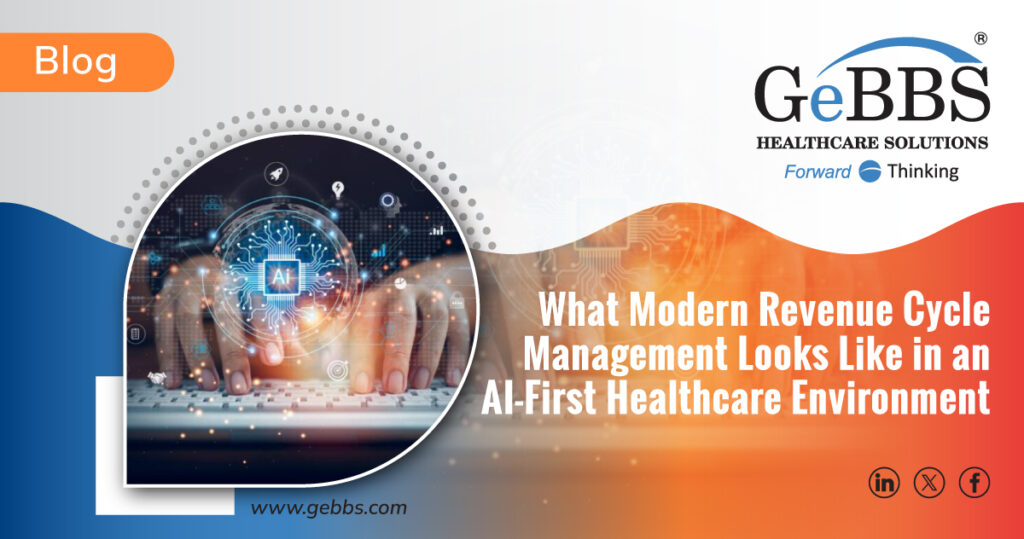
An AI-first revenue cycle management changes that.
Instead of staff manually tracking down every issue, AI-enabled workflows can help identify risk earlier and route work intelligently. For example, an AI-enabled prior authorization workflow might flag a scheduled procedure that appears to lack payer approval, identify the missing documentation, and route it to the right team before the patient arrives.
This isn’t the end of manual work for your staff. But it does change their role from “I must touch everything” to “I touch what matters most.” Staff can focus on exceptions and process improvement. AI handles more of the repetitive work.
A Holistic View of the Revenue Cycle
The revenue cycle is often described as one process, but inside many hospitals and health systems, it doesn’t feel that way.
Patient access works one set of issues while HIM and coding work another, and operations tries to keep the whole thing moving. Everyone is working hard. But when the process is fragmented, hard work doesn’t always translate into better performance.
That’s because revenue cycle problems rarely occur in isolation. A front-end registration error can create a billing delay weeks later, or a documentation issue can affect coding accuracy. It’s all connected. An AI-first RCM environment is built around this connected view. It uses data across the patient-to-payment lifecycle to help organizations understand not only what happened, but why it happened and where to intervene next.
For example, imagine a health system notices a spike in denials for a specific service line. In a traditional model, the denial team may work the appeals one by one. While that’s necessary, it’s not enough. A more modern model looks upstream. Is the issue tied to electronic prior authorization? Coding? A payer rule change? That’s where AI and analytics can help connect the dots.
Instead of treating each denial as a separate fire to put out, the organization can identify the dry brush feeding the flames. The root cause. Because the goal isn’t simply to work denials faster. It’s to prevent more of them from happening in the first place.
How Do Humans and AI Work Together?
None of this means hospitals should hand the keys to AI and hope for the best. That may be the biggest misconception in the conversation. AI-first doesn’t mean AI-only.
RCM touches reimbursement accuracy, compliance, payer relationships, patient financial experience, and protected health information. These are not low-stakes workflows. A wrong recommendation or an unmonitored automation can create real risk. That’s why modern RCM needs governance baked into it.
Governed AI means there are clear rules for how automation is used, where human review is required, and how performance is monitored. It means high-risk or complex decisions don’t disappear into a black box. It means audit trails, role-based access, data security, PHI protection, and validation of AI outputs are treated as core operating requirements.
For instance, AI may help draft an appeal letter by pulling together denial details and gathering supporting evidence. That can save time. A lot of time. But in a governed workflow, a qualified human still reviews the appeal before submission, especially when the case is high-dollar or clinically sensitive.
Think of AI like a junior staff member. It can handle a lot of tasks but it can still make mistakes. It still needs experienced staff to handle complex cases and decide when something doesn’t look right. That’s why people are essential to the process.
AI Lays the Groundwork for a More Resilient Revenue Cycle
It’s understandable to look at AI-first healthcare revenue cycle management with some skepticism. When teams are buried in denials and struggling to keep up with payer policy changes, another promise of transformation sounds like noise.
But when applied right, AI can help create a calmer, clearer operating model.
Imagine a different type of morning. One where your team logs in, and the system has already begun pulling the right work forward. No more waiting for a denial-prone account to drift downstream or a missing authorization to stall care. Your organization can see the risk earlier and act while the window is still open.
Now your staff has the bandwidth to solve problems more effectively. That’s the real promise of AI-first RCM—a revenue cycle with fewer mistakes and a team with more room to breathe. Building an AI-first revenue cycle isn’t as simple as plugging in another tool. The real question is, can your workflows, data, and teams work together in a smarter way? GeBBS helps your organization do just that. With AI-enabled capabilities and deep operational expertise, we help teams reduce manual work and keep revenue moving with more clarity and control. It’s the modern revenue cycle you’ve been hoping for. One where there’s less constant cleanup and more efficiency. Contact us today to learn more