Healthcare organizations have spent years investing in denial management technology. Yet for many revenue cycle teams, it can feel like little progress has been made. You’re still fighting the same battle day after day….
A denial arrives. And what should be a routine recovery suddenly becomes a race against the clock. Documentation needs to be located. Requirements need to be verified. Someone has to determine why the claim was denied in the first place. As teams bounce between payer portals, emails, and spreadsheets, the process slows under the weight of its own complexity. Then another denial arrives. And another. It never ends. You’re stuck in a loop that you and your team just can’t escape.
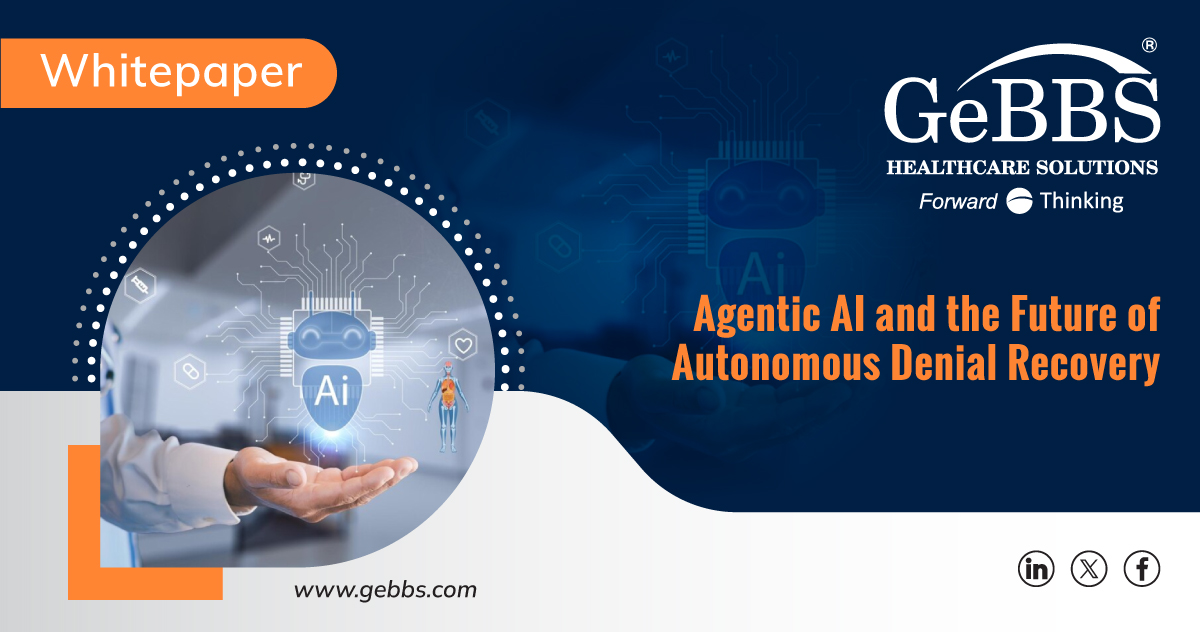
Agentic AI offers a fundamentally different approach. Rather than simply helping staff complete tasks faster, it introduces autonomous AI agents. These “digital workers” can coordinate, reason, and execute denial recovery workflows with minimal human intervention. The payoff is a more scalable recovery operation.
This white paper explores this historic shift happening in the revenue cycle now. We begin with the current denial crisis in healthcare, the evolution of denial management technology, and the emergence of Agentic AI denial recovery. The paper then pulls back the curtain on how Agentic AI denial management works, breaking down how a team of AI agents executes many of the routine tasks that have bogged down recovery teams. Finally, we’ll cover the governance and oversight structures that foster trust in the AI system, as well as the technology’s benefits.
As reimbursement pressures intensify and payer complexity grows, incremental improvements won’t cut it anymore. A new operating model is needed. The organizations that adapt first will be best positioned to protect revenue tomorrow.